The cost of asking: designing AI for my grandparents
I watched my grandparents try AI. It already lowers the cost of asking for help. It doesn't yet lower the cost of a mistake. Here's what I would design differently.
My grandmother once reset her phone by mistake, and every contact she had was gone. She gets things done by calling people, so suddenly she couldn't reach anyone. Getting her numbers back meant waiting for people to call her, one by one.
Her phone did ask, "Do you want to go ahead with it?" But it never said what she would lose. Since that day, she asks once, sometimes twice, before doing anything on her phone. Not because she can't do it, but because she doesn't want to make another mistake she can't undo. And asking isn't simple either. Everyone is busy, so asking means waiting, and she hates disturbing anyone. So she waits.
I grew up with my grandparents. It's a bittersweet moment when you realize that the people who made you so confident, independent and ready to take on the world now need help with everyday things on a phone.
The hardest part of technology for my grandparents isn't the skill. It's the cost of asking for help, and the cost of a mistake. As a designer, I wanted to see if AI could lower both.
What happened when they tried AI
So I sat with both of them and had them try Google Gemini, which came free with their phone plan. This wasn't a proper study, just me, my grandparents and a phone.
My grandmother thinks in Gujarati, her mother tongue. Typing in Gujarati is slow, so on WhatsApp she sends voice notes instead. She asked Gemini a question the same way, in a voice note, in Gujarati, and it understood her. It gave her the steps, and she tried to do it herself. But inside Settings she couldn't find some of the options it mentioned, and she wasn't sure if she was doing it right.
Still, it felt better than asking family, because at least she could say, "I tried to do it myself first."
My grandfather is different. He loves technology. Once, one wrong click made a whole screen of apps disappear from his phone. He spent a couple of hours on it, then my uncle tried, and neither of them could fix it. I found the solution on Google in minutes. The only difference was that I knew what to type, and he didn't. When he tried Gemini, he typed one vague sentence, and it gave him multiple options to try, because it knew what could have happened. He followed the steps, and it worked.
So AI already lowers the cost of asking. It understood both of them, it never got impatient, and nobody was disturbed. But it didn't help with the two things that scare my grandmother most: not knowing if she's doing it right, and making a mistake she can't undo. Gemini can look at your screen if you turn on screen sharing, which would have helped with the first, but she didn't use it, and nothing suggested it to her. So she was left reading steps and hoping she got them right. The most helpful feature was invisible to the person who needed it most.
What they actually want
My grandparents have never depended on anyone, so their first instinct is to try things themselves. They even believe that getting immediate answers makes you lazy, which is a real tension for AI, since immediate answers are exactly what it's built to give. They don't want technology to just do things for them, and they don't want to be treated like kids. They want someone patient enough to hold their hand while they do it themselves.
And there's a limit to how far they'll trust it. Even my grandfather, the confident one, says: "We don't know what to do with cards and digital payments. What if something goes wrong? Who do we go to?"
What I would design differently
One answer would be to let the AI do it for her. Today, assistants like Gemini mostly tell you what to do and can only do a few things themselves, when you ask and give permission, but that's changing. Even so, I don't think it should jump straight to doing things for her. If her phone suddenly started changing things by itself, she would freak out.
The change can't be abrupt; she needs time to get comfortable first. So it should take over slowly: first it shows her how, then it does small things with her permission, always telling her what it's doing and why. After she's cleared her storage with it a few times, it might ask, "Want me to do this for you next time?" That way she never feels like her phone is acting on its own, and anything she can't undo is still her decision.
Make the most helpful feature the obvious one. When she gets stuck, the AI should offer to look at her screen, ask her first, and then highlight exactly where to tap, one step at a time. And it should do this inside WhatsApp, where she feels at home, in Gujarati and by voice, the way she talks.
Only say "you're right" when it knows. Before telling her "Yes, you're in the right place," it should check what's actually on her screen. And when it isn't sure, it should say so plainly instead of guessing. For someone scared of getting it wrong, an honest "I'm not sure, let's check" matters more than a fast answer.
Say what will be lost, not just "are you sure?" Her reset warning only asked if she wanted to go ahead. A warning should name the loss in plain words, in her language, and offer a backup first. And when something can be fixed, like my grandfather's screen, the way back should be offered right there.
All of this comes with a cost. Seeing her screen and remembering where she got stuck means the AI knows a lot about her. So it should only look when she says yes, show clearly when it's looking, and let her see and delete what it remembers. Since my grandparents share an account, it also needs to know whose phone, and whose memory, it is. And for big things like payments, she should be able to bring a family member into the same chat, usually my grandfather, since she's with him most of the time, so the decision stays with people she trusts.
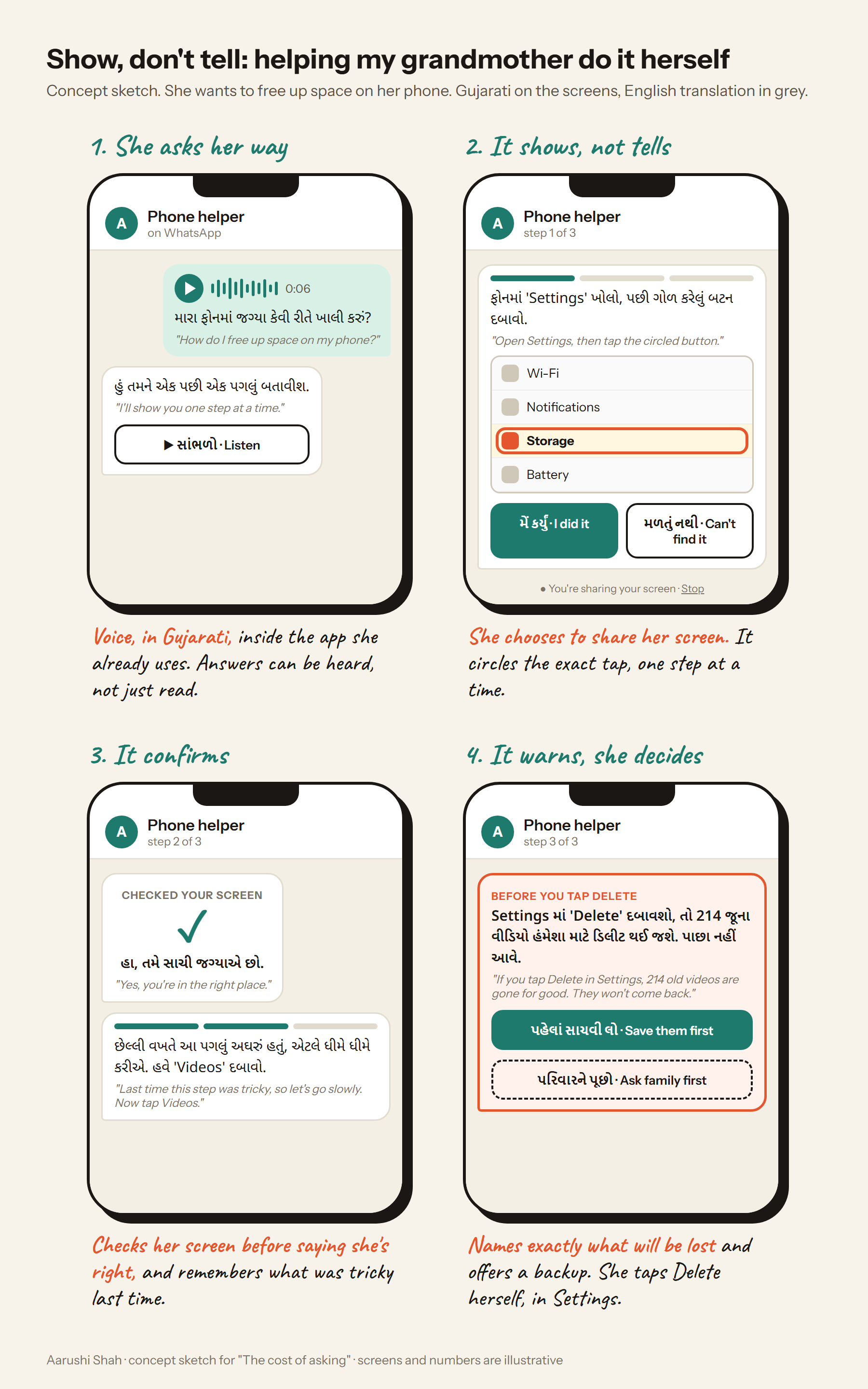
A concept sketch of what this could look like for my grandmother.
What I would test next
Two people isn't proof, so the next step is testing it properly. I would build these four screens as a simple prototype and give my grandmother a real task, like clearing space on her phone. Success would mean she finishes without calling anyone, has fewer "am I doing this right?" moments, and says afterwards that she would try it again on her own. Then I would test it with five more people who didn't grow up with technology, outside my family, to learn what is specific to my grandparents and what is true for more people.
What still worries me
AI can sound sure of itself even when it's wrong, and everything above only helps if it really checks. I can usually tell when an answer feels off. My grandparents can't always. And the more they trust a patient, helpful voice on their phone, the easier it becomes for a scam to imitate one.
My grandmother isn't unusual. Millions of people are coming to smartphones, and now AI, without having grown up with either, often in a language the phone wasn't designed around. AI has already lowered the cost of asking for them. Lowering the cost of a mistake is a design problem, and it's the one I want to work on, so that the next time my grandmother tries something on her phone, she gets to say she did it herself.
